
Community Fuel Breaks
What is a fuel break?
A fuel break is defined as, "a strip or block of land on which the vegetation, debris and detritus have been reduced and/or modified to control or diminsh the risk of the spread of fire crossings the strip or block of land."
Reference: NRCS. Conservation Practice Standard: Fuel Break. CODE 383. April 2007.


What is a shaded fuel break?
A shaded fuel break is a strip of forested area between 100 - 400 feet wide. In shaded fuel breaks the goal is to reduce surface and ladder fuel, ultimately reducing vegetative density in the understory. Trees are spaced out and branches are pruned to 10 feet high. Fire intenstiy and the rate of spread are altered so that suppression resources can be engaged more safely and effectively.

Why are fuel breaks key to helping stop wildfires?
Fuel breaks are essential to helping firefighters establish control lines and slow wildfire spread. With the reduction of brush and ladder fuels, fire intensity lessens and the flames remain at ground level, instead of spreading into the canopy. Read more about the Tiger Creek Fuel Break and it doing its job for fire crews to stop the Tiger Fire at the U.S. Department of Interior Bureau of Land Management. Fuel breaks alone will not save communities; however, they are a strategy that can be used to reduce severity and provide time for first responders to respond.
Fuel Breaks in Amador County
Initial Treatment Year: 2002
Length: 6.5 miles
Acres: 268
Initial Treatment Year: 2022
Length: 11 miles
Acres: 376


Initial Treatment Year: 2023-2024
Length: 1.25 miles
Acres: 36


Initial Treatment Year: 2024
Length: 2.25 miles
Acres: 240
Tiger Creek is often described by AFSC as the “perfect fuel break,” and with good reason. Post‑treatment regrowth has been dominated by bear clover, which provides ground cover while maintaining low fire‑severity risk. Just as importantly, the project represents a true grassroots collaboration. Tiger Creek is part of a broader network of fuel‑reduction efforts that span multiple landowners and jurisdictions, including BLM, the Forest Service, PG&E, CalFire, SPI, and numerous private landowners. It continues to serve as a model of coordination and partnership across Amador County.
Press Release
AFSC Tiger Creek Fuel Break assists in knockdown of Tiger Fire
Tiger Fire PR 2025 - AFSC.pdf
In the News
Ledger Dispatch - "Fuel Break Assists in Containment of Tiger Fire"
Aug 15, 2025 | Updated Jul 22, 2026
Tiger Creek Fuel Break - The Perfect Fuel Break


Initial Treatment Year: 2025
Length: 6.5 miles
Acres: 281


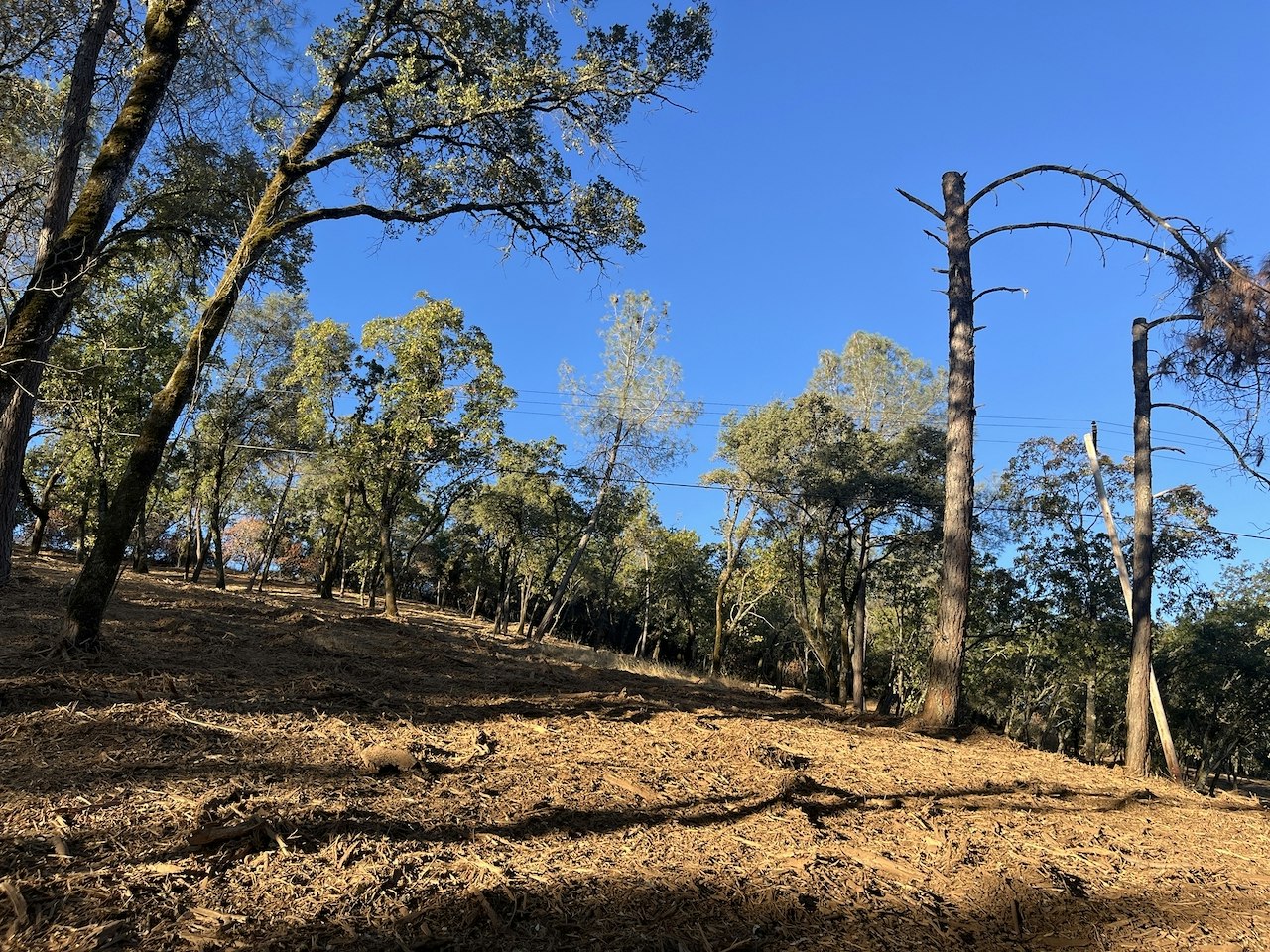


Initial Treatment Year: 2025
Length: 0.5 miles
Acres: 33
Initial Treatment Year: 2026
Length: 6.5 miles
Acres: 299
Initial Treatment Year: 2026
Length: 0.75 miles
Acres: 58
- Ingram, C. Kimberly. (2022, July 15). Herbicide Use for Treating Invasive Plants: One Tool in the Forest Landowner Management Tool Box. Blog - Forest Research and Outreach. https://ucanr.edu/blog/blog-forest-research-and-outreach/article/herbicide-use-treating-invasive-plants-one-tool
- UC ANR. (2026 March). Managing Competing Vegetation with Herbicide: Factsheet. Forestry Research and Outreach. https://ucanr.edu/site/forestry-research-and-outreach/document/managing-competing-vegetation-herbicide-factsheet
- UC ANR Fire Network. Herbicide. University of California Agriculture and Natural Resources. (Accessed 2026 Oct 15). https://ucanr.edu/program/uc-anr-fire-network/herbicide-0
- UC ANR Fire Netwok. Reducing Forest Fuels. Univsersity of California Agriculture and Natural Resources. (Accessed 2026, Oct 15). https://ucanr.edu/program/uc-anr-fire-network/reducing-forest-fuels
- USDA. Fuel Break - Forestland. Natural Resources Conservation Service Conservation Practice Specifications (Ac.) Code 383. (Accessed 2026, Oct 15). https://efotg.sc.egov.usda.gov/api/CPSFile/20901/383_PS_CA_Fuel_Break-Forestland_05-2020